
@silverstag
Forum Replies Created
-
AuthorPosts
-
SilverStag
ParticipantI went archive diving this week, to be absolutely sure everything I had was shot with a prime: all my shots are from “A time before Zooms” (ca. 1978)
I went with photos that have a story behind them, just in case anyone asks 😉
ParticipantThe only thing I could reasonably disqualify at this point would be a zoom-during-exposure. Smoke ’em if ya got ’em.
I am so tempted to build a slide rig at this point 🙂
ParticipantSome of mine are cropped from 2:3 to 4:5 ratio, which is what rav is talking about up above there, I think. I think that’s about the limit, though.
ParticipantI guess everything I took before 2000 is eligible for this contest, since that’s when I got my first zoom lens.
ParticipantWell, SilverStag‘s in there too 😉
Which kind of surprised me: that’s a copy of a 34-year-old Ektachrome 64 transparency, that I threw in there to have a round 3 entries. I actually think I took that in either Orlando or Jacksonville, FL.
ParticipantThese astronomical photo-ops are a useful weather prediction tool- I can tell, sometimes months ahead of time, what nights will be overcast or rainy.
ParticipantMy votes, in no particular order:
Now I Lay Me Down to Sleep
ACLU
St. Jude Children’s HospitalNILMDTS gets a vote because it’s a caring organization, performing a sensitive service in very trying conditions. It has to take a strong heart to do that work, I’m pretty sure I couldn’t.
ACLU – because I fear more now for our liberties than at anytime in my life previously.
St. Jude’s – because they never turn truly needful children away. Amazing people and philosophy in this day and age.
ParticipantThat post is gone now.
Good Riddance! Woulda been gone last night if I had the Wand of Deletion.
ParticipantYou don’t need HDR if you’re patient:

Tenth Street Bridge by pjern, on FlickrThis was the result of being there at the right time of day with the right kind of weather. I don’t think you could cram much more dynamic range into an image without using HDR: There is a very small cluster of blown-out white pixels in the upper left of the sky, and a very few pixels at #000000.
The only adjustments to this image is a curves layer to redistribute some of the midtone values and a very small contrast boost.
ParticipantWell, I only have one prime lens, so this is an easy choice for me 🙂
ParticipantHmm. Could I take a shot at that original? Is it RAW or JPG?
It’s in raw, here is a link to the original in Canon Raw
http://www.freeversephotography.com/_MG_8790.CR2
You know, however, if you take it and use software to normalize or equate to the HDR shot, that is going to prove Elsinore‘s point? 😀
Hmm, my very first Canon Raw.
Here’s what I came up with:
The first thing I notice is that it looks much more orange-y and saturated in the browser than it does in Photoshop. Hmm.
What I did:
In Camera Raw, I adjusted the exposure- the original seemed to be underexposed by about 2 stops.
I used the fill light in ACR to lighten the deep shadows a bit. This reduced contrast, but I was going to get that back in CS3.
Opened in CS3-change to LAB mode-smart sharpened the lightness channel- did the LAB mode color boost trick.
Back to RGB mode:
Did a Soft Light layer to add back the contrast lost in ACR (Camera Raw) Adjusted the effect using the opacity slider.
Flattened
Did a multiply layer to intensify the color. Looking at it in the browser, I think I didn’t dial it back enough with the opacity slider.
Flattened, converted to 8 bit, Saved as Jpg.
(Edited) I opened this up in IE9, and Chrome to compare with my default Firefox. Both of those browsers much more closely match Photoshop than Firefox. I wonder if there’s an adjustment for color space in Firefox?
ParticipantI’m enjoying the give and take here; I’d like to see more people participate.
FWIW, I think you’re right. The method you use is a digital analog (HA!) of a accepted darkroom process. I would say it is fair to use in Farktography.
In re: the color shift: Cameras are notorious liars to begin with, and a camera as demonstrably imperfect as a digital camera lies even harder. I was trying to recover the remembered color of the dawn hour where the sun was just reaching the mountaintop, and the dark sky beyond provided an extraordinary contrast. The meter in the camera bollixed up the exposure for fair, so it was up to me to try and recreate what I saw and felt.
Of course, I make the same argument about HDR. The best correction of this shot:
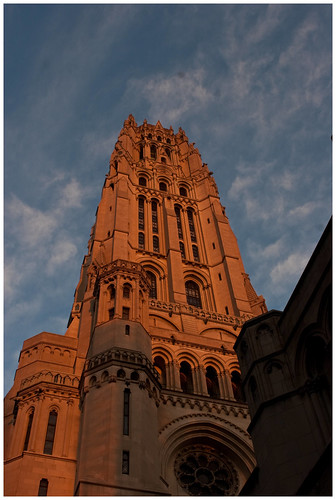
is just to dark, the sky is dropped off and the shadows deeper than they really were, also the color of the stone in the sunrise was shades redder than the captured.
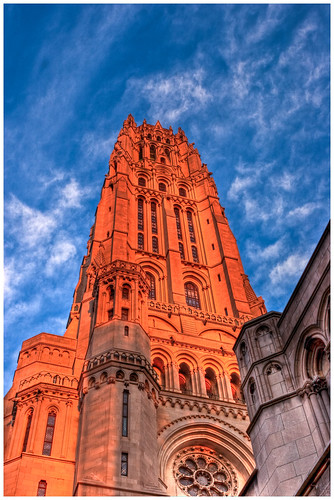
So, using a HDR I am closer to the tonal range of the actual conditions. Looking back at this shot, I should actually cool the temperature of the shot down but with the sun hitting the building just over the horizon, this was as close to the actual scene as I could make it. And I couldn’t do without the software.
Hmm. Could I take a shot at that original? Is it RAW or JPG?
ParticipantJust a note to say this is an educational thread. I’m 1/2 lost in it, but am grasping the larger concepts. I should take a photography class. There seems to be much to learn.
I’ve been doing it for 40 years, and I learn new stuff all the time. It’s a life-long project if you let it be 🙂
I’m glad to see people participating and getting something out of it. rav, why not ask about the things that are unclear? Someone will undoubtedly chime in to help you out 🙂
ParticipantPlease don’t take this as a personal attack. I’m just sort of Farktography old-school I guess, and it just seems to run counter to the spirit of the rules (“show us your camera skills/we don’t care much about your computer skills”) even if it’s in line with the current wording.
I don’t take it personally:) I think that we can have these discussions in the spirit of give and take and not get bogged down in derails, and that Farktography will be healthier for it.
Let us, for a minute, assume that Farktography took place in the real world, and every Thursday we had a photo contest in Lexington, KY. People would certainly do their best for that sort of venue. Printing and presentation would play a part in how photos were received, as well.
Now, bring us back to digital world: Experience shows that the voters are a fickle bunch, and are just as easily swayed by a cute kid or Farky goofy photo as great photography. How do you stand out in that bunch?
The playing field is pretty much leveled on presentation: nothing is going to be any wider that 640 pixels, and pretty piss-poor web quality at that because of the file size limits. I don’t think it matters that much what you do to the photos at that point because it’s not going to make it stand out that much more- the playing field is pretty much a billiard-table.
I am sure that every one of us cares about our work, or we wouldn’t be here. I’m simply trying to be a voice for good and even some great photography to find its way into the contest. When I was in photojournalism class way back in 1970 with Mr. Bolander, he told us that great photographers weren’t just good with the camera- they had to have the whole skill set whether they used it all or not- Studio lighting, action shooting, darkroom tricks, retouching prints with a fine sable brush, everything. Maybe I was fortunate that I had such a fine and skilled teacher, but I’ve always believed that if you have the tools, you use them to get the result you want.
ParticipantI’d beg to differ, but your understanding and my understanding of HDR may be quite different. HDR is an artificial construct originally designed to counter the limited dynamic range of digital images. To a limited extent, the curves tool in Photoshop (or its GIMP equivalent) can be used the same way to artificially stretch the apparent dynamic range of an image.
HDR is a solution in search of a problem at this point: Displays that can display true HDR and printers and paper that can print it do not yet exist, for all practical purposes, outside of a few very specialized experimental devices. You’re not likely to get one at Best Buy anytime soon.
Where HDR gets in trouble is in the tone mapping process, when heavy-handedness creates the psychedelic effects that make it so (rightly, IMNSHO) despised. If you want to create a psychedelic montage of a Disney scene, fine. Just don’t make me look at it 🙂
Now, to your criticism of my methods:
Lets say I’m in the darkroom, and I make a test print that looks like the straight B&W conversion above. How might I produce the bottom version? The first step is going to be to choose a much more contrasty paper/developer combination, say Ilfospeed RC Deluxe grade 4 in RC developer 1:9.
Another test print is now in order to see if we have the contrast correct. (This is analogous the Soft light filtering over the entire image in the virtual darkroom).
Now, I’ll look at the print and decide what corrections I need to make. I want the grasses and fence in the foreground to stand out (i.e. be lighter) by about 1 stop, so I’m going to start dodging the bottom half after about half the average exposure time. (Screen mode and a layer mask to be the virtual ‘cardboard’ used for the dodging. The computer ‘mask’ is applied counter to logic, since i want the dodged effect to be the lower half of the image.)
As the exposure progresses towards the nominal time, I’d slowly move the (in the physical world) mask upwards to the point where I want the ‘burning in’ to begin. I’d then let the exposure time progress towards double the nominal exposure in order to ‘burn in’ the sky and the mountain a stop (or more).
I don’t think that it should be a hard concept to see the analogies between what I do in Photoshop and what I did over 30 years in darkrooms.
In re: the color shift: Cameras are notorious liars to begin with, and a camera as demonstrably imperfect as a digital camera lies even harder. I was trying to recover the remembered color of the dawn hour where the sun was just reaching the mountaintop, and the dark sky beyond provided an extraordinary contrast. The meter in the camera bollixed up the exposure for fair, so it was up to me to try and recreate what I saw and felt.
If you think I manipulate my images too much, I might encourage you to read some Ansel Adams, notably The Print or Examples for some insights into the whys and wherefores. I think a lot of it is still applicable today.
I’m enjoying the give and take here; I’d like to see more people participate.
(Editing to say when I used the word criticism, I was trying to use it in an academic or prescriptive manner, not pejorative. Just for the record.)
-
AuthorPosts


